Ford F-450 Super Duty Cover: Cab Configuration, Freeze-Thaw, and Winter Protection for the Heavy-Duty Lineup
<!-- PRODUCT INJECTIONS START -->
Read the story →
Materials science, lab tests, and ownership stories from DaShield's R&D in Buena Park. Long-form only. No sales emails.
<!-- PRODUCT INJECTIONS START -->
Read the story →
<!-- PRODUCT INJECTIONS START -->
Read the story →<!-- PRODUCT INJECTIONS START -->
Read the story →
The Lexus GS 350 was discontinued after the 2020 model year. Every example on the road today is a used vehicle — and for a discontinued luxury sport sedan with no replacement in production, the owner's calculus around paint protection is di
Read the story →
Most products sold under the label "luxury car cover" use non-woven polypropylene as the inner face. Non-woven means fibers bonded by heat or chemical process — not interlaced into a consistent surface. The fiber ends that contact your IS 3
Read the story →
Road salt deployed at 250 to 350 pounds per lane-mile — the pre-treatment standard used by state DOTs across the snow belt before winter storm events — creates a chloride aerosol that extends 50 to 100 feet from the road surface. A GMC Sier
Read the story →The cover was a 5-door hatchback template on an XP150 Yaris sedan. At 157.9 inches, the hatchback pattern left 14.5 inches of trunk lid and rear bumper sitting outside the cover's rear hem — the entire trunk area had been exposed for two ye
Read the story →Paint correction on a BMW 5 Series runs $400 to $1,200 at a shop qualified to work on BMW metallics. Clear coat respray on a panel group is $1,800 to $3,500. Full exterior respray on a G30 530i is $10,000 to $25,000. A DaShield Vanguard UHD
Read the story →
The Murano CrossCabriolet shares a platform with the Z51 Murano SUV. We assumed that meant it shared a cover template. It doesn't. When the CrossCabriolet's soft top is folded and retracted, the canvas and mechanism stack sits above the rea
Read the story →The BMW X3 grew 5.8 inches across three generations — from the 180.5-inch E83 that launched in 2004 to the 186.3-inch G01 still in production today. That gap is large enough to produce visible slack or contact tension depending on which dir
Read the story →
At 126.0 inches in overall length, the Suzuki Samurai is one of the shortest SUVs ever sold in the United States — and that single dimension creates a fitment problem that most cover buyers do not anticipate. Covers marketed as "compact" or
Read the story →
Honda built 66,542 S2000s for the US market across exactly ten model years. Both the AP1 (1999–2003) and the AP2 (2004–2009) measure 162.8 inches from bumper to bumper — the same number on a spec sheet. What that number conceals is the reas
Read the story →<!-- PRODUCT INJECTIONS START -->
Read the story →<!-- PRODUCT INJECTIONS START -->
Read the story →
The NOAA UV Index reaches 10 or higher for three to five consecutive hours per day in Buena Park from June through September. We set out to measure what that means for clearcoat surface temperature on a parked Continental. Covered surfaces
Read the story →The BMW 430i nameplate covers nine distinct vehicles — and we built the wrong cover template for the Gran Coupe the first time. Not wrong in the sense of poor fabric selection. Wrong in the sense that a cover sized for an F32 coupe reaches
Read the story →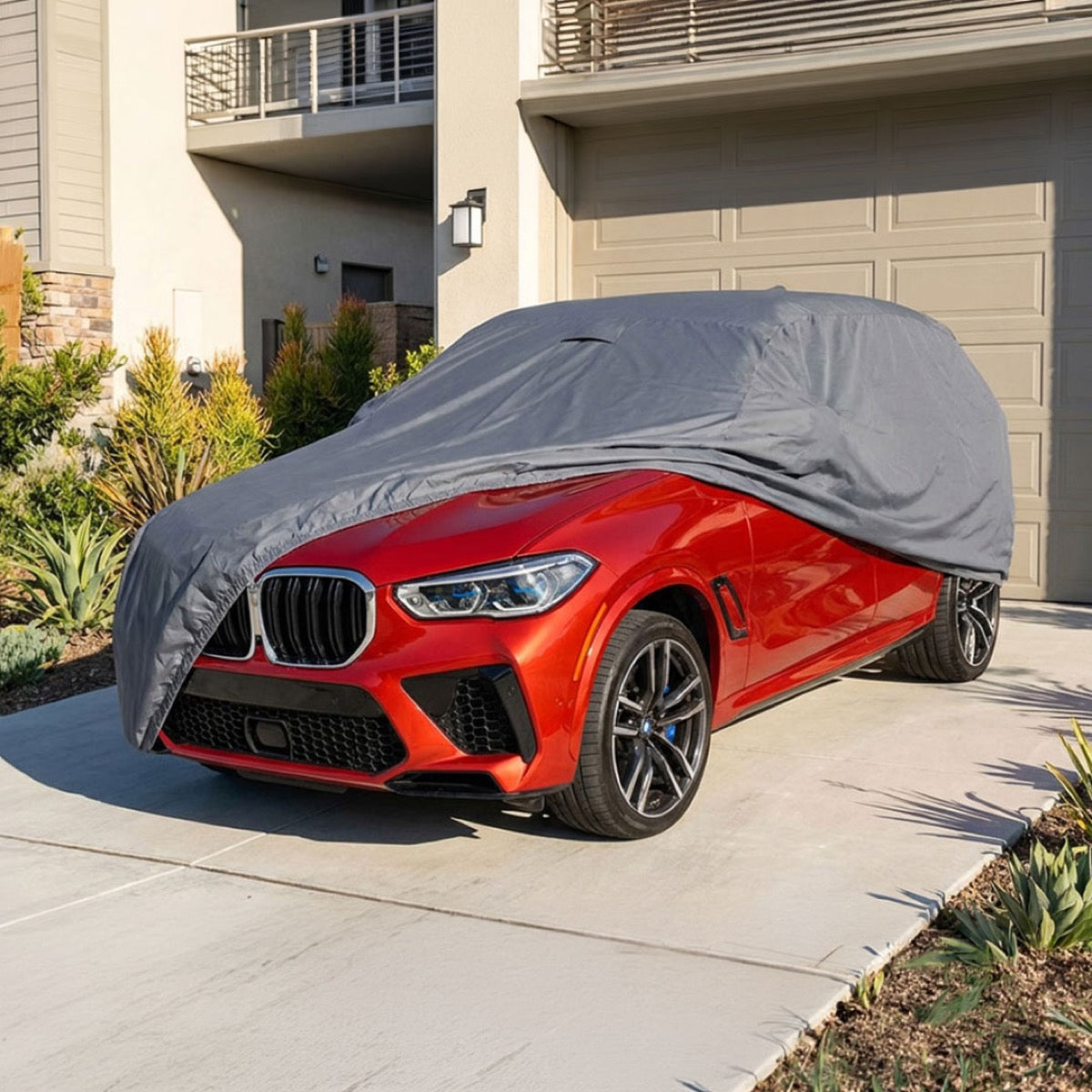
A standard BMW X6 respray at an authorized body shop runs $8,000 to $12,000. A vehicle specified with BMW Individual paint — Frozen matte finishes, hand-applied metallics, or bespoke color-match options — runs $15,000 to $30,000 for a full
Read the story →<!-- PRODUCT INJECTIONS START -->
Read the story →The car cover industry organizes vehicles into size categories: compact, mid-size, full-size sedan. The Cadillac XTS lands in full-size, and most manufacturers issue one pattern built to a 185–205-inch range with a disclaimer that reads "fi
Read the story →The most damaging cover you can put on a 1962 Chevy II is a waterproof one. Not because waterproofing is bad — but because nitrocellulose lacquer needs to breathe. Seal the surface and you trap ambient humidity against a finish that has bee
Read the story →A corporate fleet manager in Sacramento sent us a photo three years ago. Six Equinoxes lined up in a company parking lot. Four of them had covers. Two of those four covers were Gen 2 templates applied to Gen 3 Equinoxes — 4.7 inches too lon
Read the story →<!-- PRODUCT INJECTIONS START -->
Read the story →<!-- PRODUCT INJECTIONS START -->
Read the story →Clear coat respray for a Dodge Durango SRT Hellcat at a shop that handles wide-body vehicles: $2,800 to $4,500. Hail PDR on a Gen 3 Durango hood and roof after a Great Plains event: $2,500 to $6,500 depending on dent count and panel access.
Read the story →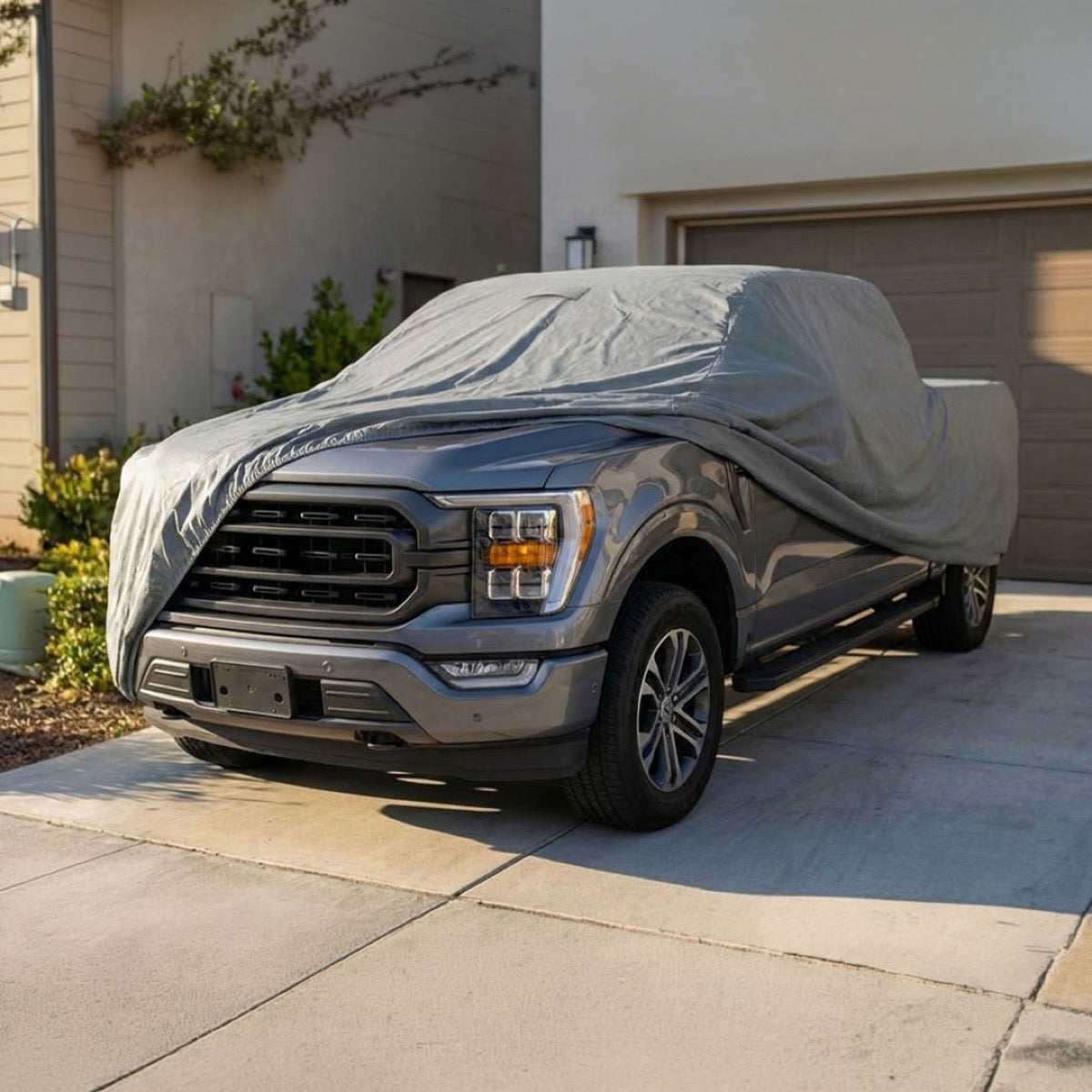
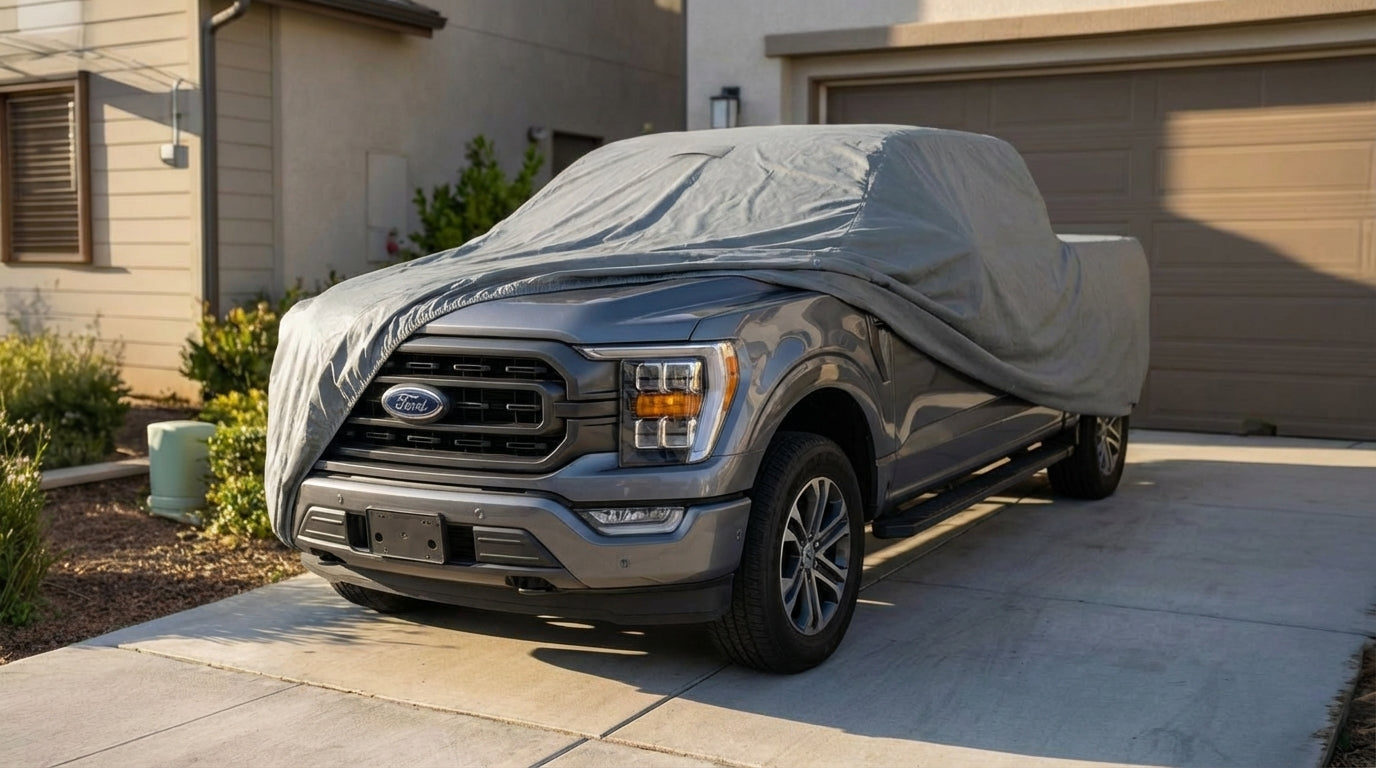
We built the first F-450 cover pattern with one configuration in mind: Crew Cab, long bed, DRW. That was the problem we were solving. DRW — dual rear wheel — adds substantial width at the rear axle, and a cover built for a standard-width tr
Read the story →Color sanding and re-lacquer on a Ford Super Deluxe panel: $1,800–$3,500. A full body respray on original Ditzler cellulose lacquer: $5,000–$15,000. Body-off museum-quality restoration with period-correct lacquer: $30,000–$80,000. DaShield
Read the story →Phoenix, 2022. A fleet manager who picked up a former police interceptor — sixth-gen Taurus, 2017 — ordered a cover online and specified Ford Taurus without confirming the generation. What arrived was sized for a fifth-gen body: 202.9 inche
Read the story →<!-- PRODUCT INJECTIONS START -->
Read the story →<!-- PRODUCT INJECTIONS START -->
Read the story →The Jeep CJ7's cover problem is not the dimensions. At 148 inches, it is shorter than a Subaru Outback. The problem is what the vehicle doesn't have — a fixed roof. We built our first CJ7 template around the factory soft-top height and sent
Read the story →SUV covers marketed for the Jeep Grand Wagoneer on most platforms are sized for the 2022-and-later WS model — a 222-inch, three-row vehicle on a modern full-size truck architecture. The original Grand Wagoneer ran from 1963 through 1991 on
Read the story →Last summer a Kia Optima owner from Phoenix sent us a photo. 2014, Gen 3, red exterior. The cover on it was a universal-fit cover from an auto parts chain — listed as fitting any midsize sedan under 190 inches. The Gen 3 Optima is 189.8 inc
Read the story →NOAA records for Phoenix, Arizona — the largest Lincoln MKZ resale concentration in the Sun Belt — show UV index 11 or higher on roughly 120 days per year. That number became the starting point when we reexamined how we were framing paint p
Read the story →<!-- PRODUCT INJECTIONS START -->
Read the story →NOAA records for Los Angeles County — the largest concentration point for R107 SL-class vehicles in active use — show UV index 10 or higher on roughly 60 days per year and UV index 6 or higher on 230 days. That figure is what changed how we
Read the story →<!-- PRODUCT INJECTIONS START -->
Read the story →The car cover market sells "Mercedes-Benz C-Class covers" as a category. C300. C350. C63 AMG. All listed under the same template. That is an industry shortcut that treats an AMG-specification performance car as a trim level of a C-Class — a
Read the story →NOAA atmospheric monitoring data for coastal California shows daily relative humidity swings of 30 to 40 percentage points — from roughly 35 percent in the afternoon to 75 percent or above overnight — through the spring and fall months. Tha
Read the story →<!-- PRODUCT INJECTIONS START -->
Read the story →In Houston, a 2001 Grand Prix GTP owner had been using a flat-hood "large American coupe" cover for three summers. It reached front to rear. Nothing looked obviously wrong. On in the morning, off when he got home.
Read the story →
<!-- PRODUCT INJECTIONS START -->
Read the story →Van covers sold in this category are patterned for conventional front-engine vans. The T4 EuroVan runs a front-wheel-drive transverse layout — rear cabin, forward passenger space — with a geometry that shares nothing with a Ford Transit or
Read the story →Paint correction on a BMW 325Ci: $600–$1,200 per panel. Clear coat respray on the hood and roof: $2,000–$3,500. Full repaint on a collector-condition E46: $8,000–$15,000. DaShield Vanguard UHD: $179.99. We'll let you do the division.
Read the story →Last summer a Volt owner from Sacramento sent us a photo. Gen 1, 2013, white exterior. The cover on it was a generic compact sedan cover from an online marketplace — correctly sized by approximate length category, incorrectly sized by gener
Read the story →Paint correction on a Dodge Dart: $400–$1,200. Clear coat respray: $1,800–$3,500. Full repaint: $5,000–$15,000. DaShield Vanguard HD: $149.99. We'll let you do the division.
Read the story →UV Index 8 is NOAA's threshold for "Very High." Phoenix, Sacramento, Dallas, and most of the Sun Belt hit that threshold for 150 or more days per year. The Ford Fiesta Mk7 ran from 2011 through 2019, which means the youngest US example is n
Read the story →Heavy-duty trucks need heavy covers — one large pattern, big enough to fit. We started with that assumption when designing for the Sierra 3500HD. We were wrong about what the hard part was. The Sierra 3500HD's fitment complexity is not its
Read the story →Most covers marketed as "vintage SUV" or "classic 4×4" covers are sized to a generic large-body silhouette. The International Scout II is 166.0 inches long. The Scout 800 it replaced is 162.5 inches. There is no generic vintage-SUV cover th
Read the story →NOAA data puts bird dropping pH below 4.5. At that acidity, etch into automotive clear coat begins within 4–6 hours in direct sunlight, when UV-driven heat accelerates acid diffusion into the clear coat surface. That sounds like a niche dat
Read the story →Most car covers marketed as "Toyota-compatible" are patterned to a sloped rear-hatch body — the Highlander profile, the 4Runner curve, the generic crossover silhouette. The FJ Cruiser has a vertical rear door with a full-size spare tire mou
Read the story →Last spring a Honda CB500F owner in Nashville sent us a photo along with a question: how do you cover a motorcycle you can't bring inside?
Read the story →Last year, an owner in Phoenix sent us a photograph of a 2019 Honda Accord sedan. The car had spent the previous twelve months on the roof level of a parking structure — covered, technically, but the cover was a $38 generic polyester unit f
Read the story →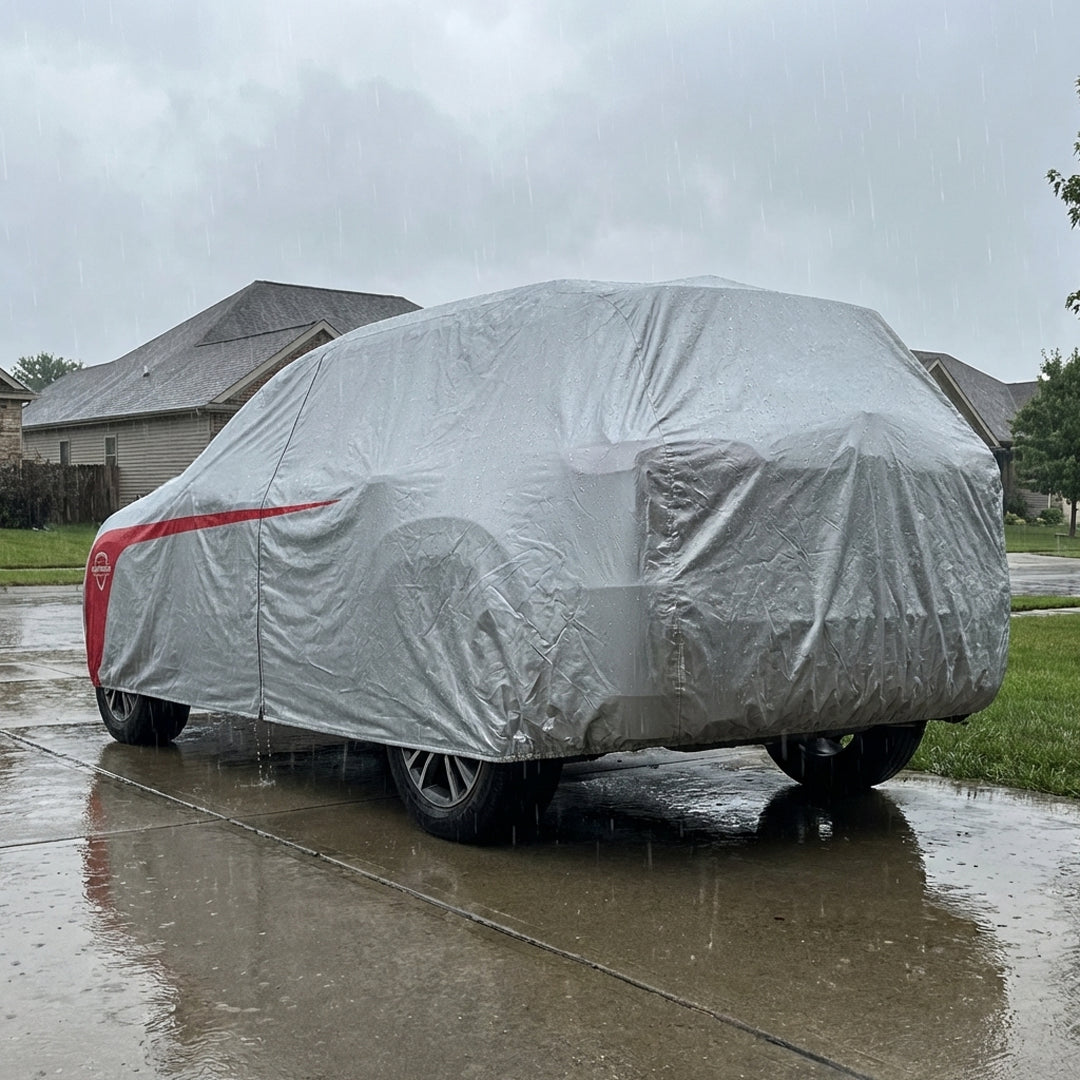
Most car covers marketed as waterproof block rain from outside — and trap humidity against the paint on the inside. That second part is the one the category does not talk about.
Read the story →
A paint scratch from an ice scraper runs $150 to $800 to touch up. Hood oxidation from one winter of salt and sun exposure — a single-panel respray — costs $400 to $1,200. Full repaint damage from road salt working through compromised clear
Read the story →Texas records UV index 6 or higher on roughly 220 days per year, per EPA and NOAA UV monitoring data. The Ford F-250 Super Duty is the dominant work truck in that state — construction sites, agricultural operations, commercial fleets. It is
Read the story →Last year, an Accord owner in Atlanta sent us a photo. 2018 Sport, black paint, outdoor parking for two years. The roof clear coat was starting to peel — driver-side A-pillar edge first, where UV exposure concentrates on a flat horizontal p
Read the story →RV covers are the largest vehicle covers we make. We assumed, for longer than we should have, that this made them simpler. More fabric, same principles — scale without added complexity. We were wrong about that.
Read the story →Most covers sold for the Subaru WRX are labeled "sport-fit" or "performance-cut." Most are standard sedan patterns with an elastic hem at the bottom. The WRX's fender flares and lower roofline are not reflected in the pattern. We're aware t
Read the story →Most products marketed as 'all-weather' SUV covers in this category are a single sheet of non-woven polypropylene. Factory cost: $3 to $7. The entire marketing argument is the word 'all-weather' on the label — not a tested mechanism, not a
Read the story →<!-- META Topic Logic
Read the story →Minneapolis averages 54 inches of snow per year. Chicago, 38 inches. Denver, 57 inches. Those numbers describe precipitation. What they mean for an SUV parked outside is something different — because the roof of a compact, midsize, or full-
Read the story →An SUV roofline is flatter than a sedan roofline. That is not an advantage for UV exposure — it is a disadvantage. We finished UV cover testing on sedan profiles in Buena Park and assumed the same recommendations applied to SUVs. They did n
Read the story →Texas records approximately 220 days per year with a UV index of 6 or above, according to NOAA UV monitoring data. Oklahoma sits at roughly 195 days. These two states represent a disproportionate share of Tundra ownership, and that is not c
Read the story →Phoenix records UV Index 3 or higher on 299 days each year. Dallas logs 234. Those figures come from NOAA and NWS UV climatology data — the same records used by the EPA to calibrate solar radiation exposure for outdoor materials. That sound
Read the story →A pickup truck is more vulnerable to hail than a passenger car — not because of size, but because the bed is a flat horizontal surface with no geometry to deflect impact.
Read the story →Surface rust treatment: $200 to $600. Bed floor panel replacement: $800 to $2,400. Cab rocker panel rust repair: $1,200 to $3,500. DaShield Ultimum truck cover: $229.99. We'll let you do the division.
Read the story →Three years ago, a 2019 F-150 owner in San Antonio sent us a photo. He had parked outdoors for two years — no shade structure, no cover. The image showed chalking starting on the horizontal surfaces: the hood leading edge, the cab roof, and
Read the story →Paint correction on a sun-damaged van panel runs $450. Roof oxidation respray on a full-size van costs $2,200. A complete repaint — the job required when UV damage penetrates past the clear coat on a Transit or Econoline — runs $8,000 to $1
Read the story →<!-- PRODUCT INJECTIONS
Read the story →A customer named David wrote to us last spring. He had spent 14 months restoring a 1979 Square Body C10 — two-tone black and silver, full rotisserie, $9,800 in custom paint from blocking through base coat. He stored the truck over winter in
Read the story →Phoenix, Arizona averages a UV Index of 11 from June through August (NOAA NWS UV Index climatology). That number means Camaro clear coat begins micro-fissure formation on a timeline years shorter than the coastal California baseline we orig
Read the story →Paint correction $600. Clear coat respray $3,000. Full repaint $15,000. DaShield Ultimum $209.99. We'll let you do the division.
Read the story →Nine fit specifications hide inside what most buyers think of as one product. The Chevrolet Silverado comes across three trim classes — 1500, 2500HD, and 3500HD — each sitting on a different frame with different fender heights, body panel w
Read the story →Last summer, a Hellcat owner in Phoenix sent us a photo. He'd ordered a Challenger cover online — the listing said "fits all 2019–2023 Challenger." In the photo, the cover was on the car. The flared fender extensions on both sides were comp
Read the story →The Charger is currently the only four-door muscle car in production. That sounds like it should make the cover simple — one body style, four doors, a conventional sedan greenhouse. We thought so too, early on. We approached the LX/LD Charg
Read the story →
Search "Dodge Ram cover" right now. Most of what comes back sells one cover for the entire Ram lineup — Regular Cab, Quad Cab, Crew Cab, short bed, long bed. One product. One listing. All Rams. We did this early on. We had a single-pattern
Read the story →The Ford Mustang has been in continuous production since 1964½ — sixty years of uninterrupted model runs that most buyers read as interchangeability. One car. Roughly the same silhouette. One cover should work. We made that same assumption
Read the story →GMC Sierra paint correction runs $800 to $1,400. Clear coat respray on a truck hood — when UV etching or hail marring goes deeper than the surface — runs $2,000 to $3,500. Full repaint after a few storm seasons without protection runs $5,00
Read the story →Most products marketed as a 'Jeep cover' in this category do not distinguish between a hard-top, a soft-top, and a removed-top Wrangler. We're aware this indicts a large portion of the industry. A Wrangler with the factory hard-top installe
Read the story →A Mini Cooper is one of the smallest cars on US roads. That does not make it easy to cover.
Read the story →NOAA classifies UV Index 6 as "High" — the threshold above which unprotected surfaces begin accumulating measurable, non-reversing damage. Across most of the US Sun Belt, that threshold holds for five to six months every year. The Model Y s
Read the story →PDR on a Tacoma hood: $800. Bed rail respray: $1,200. Clear coat failure from 3 seasons of Arizona sun: $3,000+. DaShield Ultimum: $229.
Read the story →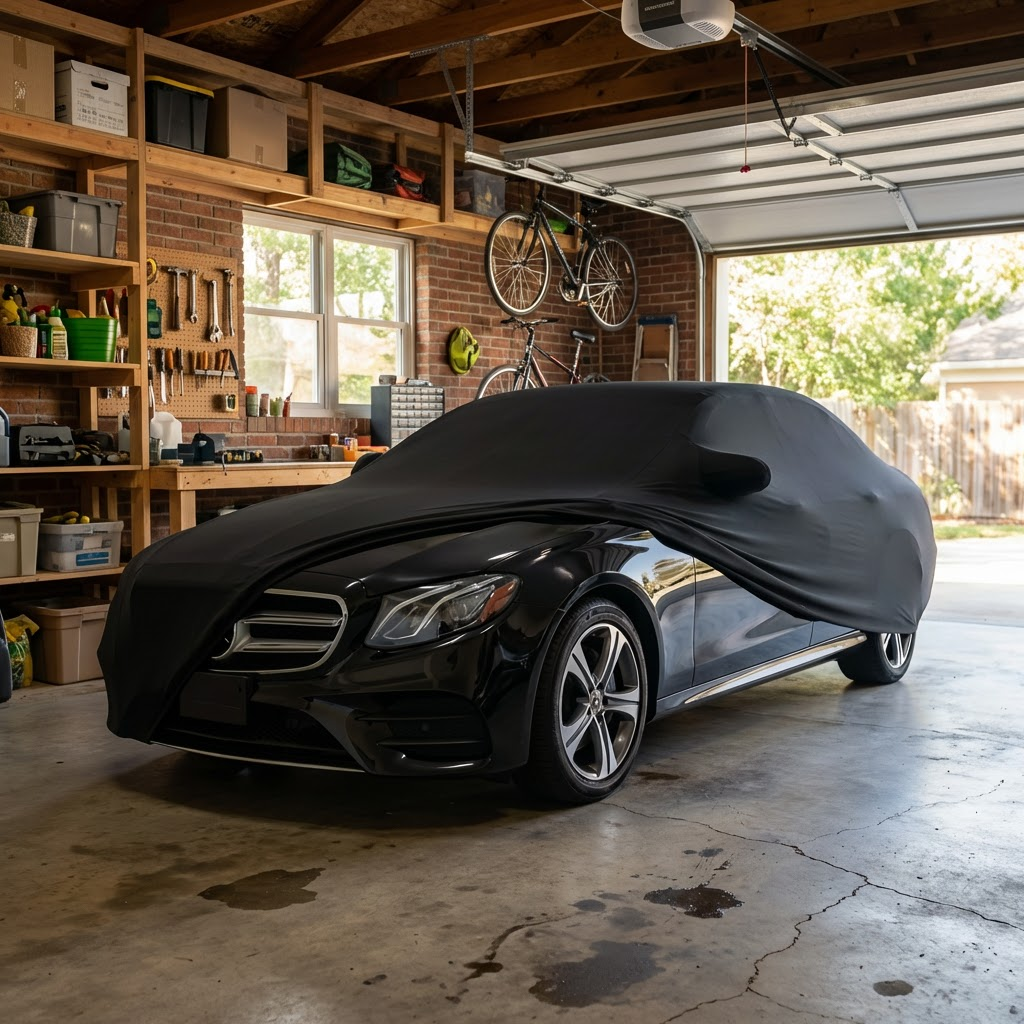
We compared the top five classic car covers side by side — materials, fit, warranty, and price. Here is what actually protects an original finish in a garage, and what does not.
Read the story →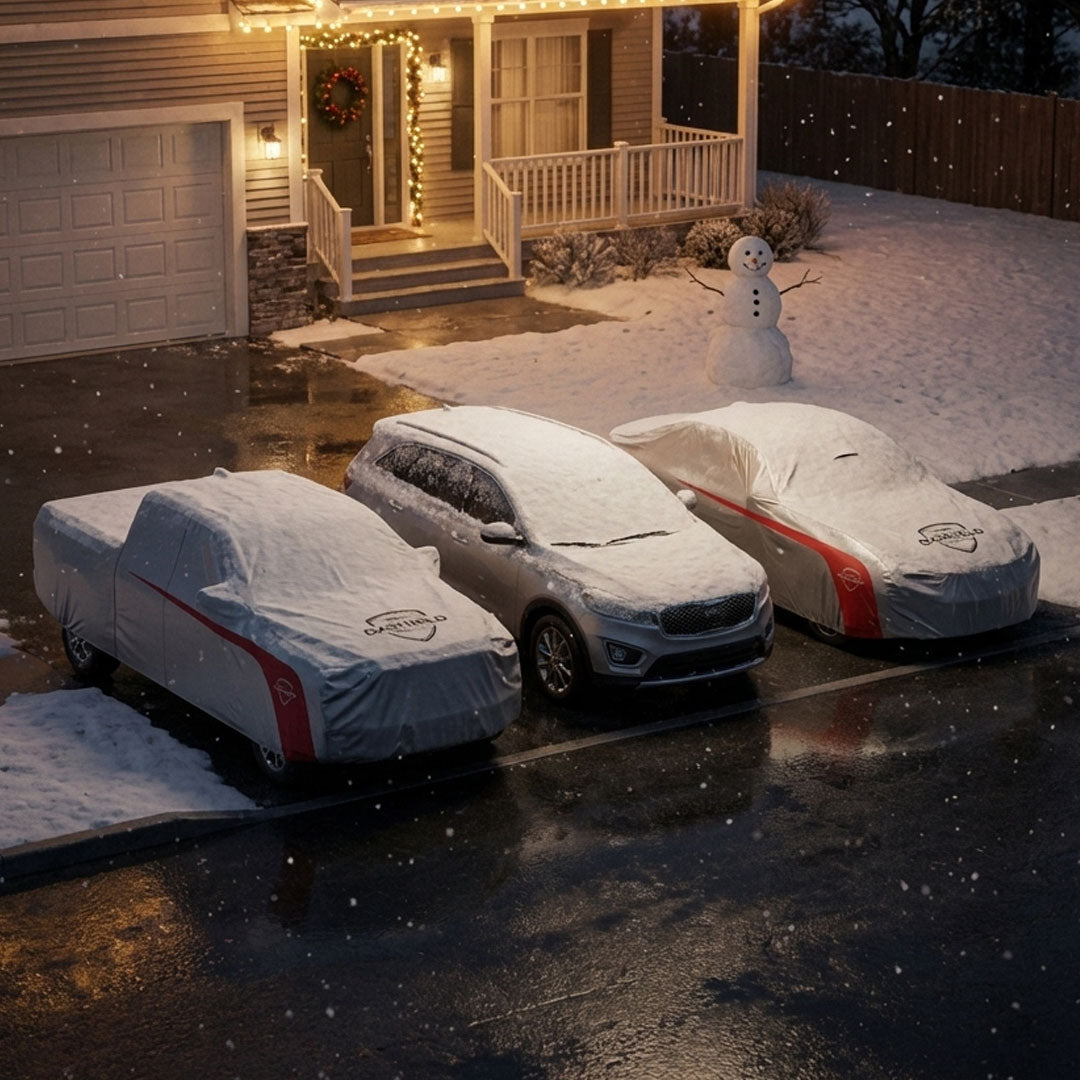
Winter is the hardest season on both cars and covers. The wrong cover turns ice into an abrasive layer against paint. A damp stored cover breeds mildew that never washes out. Here is how to do both sides right — from cover selection through spring storage.
Read the story →
A hailstone the size of a quarter carries enough kinetic energy to permanently deform sheet metal on contact — that deformation cannot be reversed without a body shop visit. This post explains the mechanism that separates a cover that prote
Read the story →
Most car covers don
Read the story →Every year an MDX owner spends in California, Texas, Florida, or Arizona accumulates UV radiation directly onto a paint system Acura spent years engineering. Lunar Silver Metallic and Majestic Black Pearl — two of the highest-volume MDX col
Read the story →The Acura TL spent two decades as the definition of attainable professional luxury. It sold to attorneys, engineers, project managers, and consultants who commuted daily, parked in surface lots and office structures without shade, and drove
Read the story →The Alfa Romeo Giulia rewards a certain kind of driver — the one who takes the long way home and knows the difference between understeer and push. That same driver tends to park assertively: tight lots, street parking, overnight on the curb
Read the story →A car cover for an Audi A3 is not a single specification decision — it is three separate decisions depending on which body style and generation you own, because Audi sold meaningfully different A3 variants in the US market across three dist
Read the story →An Audi A4 car cover is a generation-specific fit — the B5 (1996–2001), B6 (2002–2005), B7 (2005–2008), B8 (2009–2016), and B9 (2017–present) each carry different overall lengths, roofline geometries, and body profiles.
Read the story →An Audi A5 car cover is a generation-and-body-style-specific fit — the B8 (2008–2016) and B9 (2017–present) carry different overall lengths, and the coupe, sportback, and cabriolet each carry a different roofline geometry that determines ho
Read the story →An Audi A6 car cover is a generation-specific decision — the C5 (1998–2004), C6 (2005–2011), C7 (2012–2018), and C8 (2019–present) each carry distinct overall dimensions, body profiles, and variant configurations that produce different cove
Read the story →The Audi Q5's Single Frame grille and the sharp body crease running from the front wheel arch to the rear door represent two of the most expensive repaint zones on any vehicle in its class. When a grocery cart clips the Q5 in a parking stru
Read the story →An Audi R8 with Suzuka Grey paint and the full carbon exterior package represents a paint preservation problem that most car cover specifications have never addressed — because most cover manufacturers pattern their "sports car" fits to hig
Read the story →A car cover for an Audi TT is a storage decision before it is a weather decision — because the TT's collector trajectory, aluminum-intensive construction, and discontinued US production status make it a vehicle where unprotected outdoor sto
Read the story →A BMW 128i car cover needs to fit 169.9 inches — not the 182.7-inch geometry of the 3 Series E90 that dominates generic "BMW car cover" search results.
Read the story →<!-- PRODUCT INJECTIONS START -->
Read the story →A BMW 325i car cover is a generation-specific and body-variant-specific fit — the E30 (1985–1991), E36 (1992–1999), and E46 (2001–2005) each produced fundamentally different platforms with different overall lengths, roofline geometries, and
Read the story →Three generations of 328i. Three different cover patterns. One wrong choice leaves the paint exposed where it matters most.
Read the story →Same length. Different cover. The 330Ci coupe and convertible both measure 173.4 inches overall — and that shared number is where the similarity in cover requirements ends.
Read the story →A BMW 330i cover is not a generic cloth — it is a generation-specific shell mapped to the chassis that carries the paint you are protecting.
Read the story →A BMW 335i car cover is a chassis-specific fit — the E90 sedan, E92 coupe, E93 convertible, and F30 sedan each carry different overall lengths, body profiles, and clearance requirements that no single generic pattern can address correctly.
Read the story →The BMW 528i nameplate spans four distinct platform generations — E28 (1982–1988), E39 (1997–2000), F10 (2011–2016), and the G30 transition where the 528i badge was retired entirely in favor of the 530i. From first production to last, the 5
Read the story →A BMW 535i car cover is a body-configuration decision first — the E60 sedan, E61 wagon, F10 sedan, F10 Gran Turismo, and F11 wagon each carry distinct overall lengths, roofline heights, and body profiles that no single generic "BMW 535i" or
Read the story →The BMW 540i badge carries a 25-year gap in it. Produced from 1997 to 2003 on the E39 platform, the 540i designation then vanished — completely — through the entire E60 and F10 generations. BMW ran 535i and 550i through those years. The 540
Read the story →Buying a cover for a BMW 650i requires resolving three separate fitment questions before price or fabric enters the decision. Which generation chassis sits under the car — E63/E64 or F12/F13/F06? Is the body a 2-door coupe, a convertible, o
Read the story →<!-- PRODUCT INJECTIONS START -->
Read the story →The BMW M2 has two generations in the US market, and they do not share a cover. The F87 (2016–2021) measures 175.0 inches long and 71.8 inches wide. The G87 (2023+) measures 184.5 inches long and 74.4 inches wide. That is a 9.5-inch length
Read the story →A car cover for a BMW M4 is not a single purchase decision — it is four distinct decisions depending on which generation you own and what sits on top of the car. The F82, F83, G82, and G83 share a nameplate but differ by 2.7 inches in lengt
Read the story →The BMW M5 has been in production for forty years. The E28 that debuted in 1985 measured 181.8 inches. The G90 in showrooms today measures 196.5 inches. That is a 14.7-inch span across seven generations — meaning a cover sized to the origin
Read the story →A cover for a BMW X5 is a fit specification exercise before it is anything else. Four distinct body generations span 24 years of production — from the 183.7-inch E53 that debuted in 2000 to the 194.3-inch G05 that remains in production toda
Read the story →The BMW Z3 was built between 1996 and 2002 on the E36/7 and E36/8 platforms. That production window closed more than two decades ago. The car sitting in your garage is now 23 to 28 years old, and the original factory clearcoat — if it has n
Read the story →The Buick Regal has been in continuous production — with gaps — across five decades. A buyer searching for a Buick Regal cover today might own a 1985 downsized A-body coupe sitting at 196 inches in a Southern California driveway, a 2013 fif
Read the story →A Cadillac CTS car cover is a body-variant-specific fit — the sedan, coupe, and Sport Wagon each carry different overall lengths and roofline geometries, and the CTS-V performance variant adds wider fender profiles that standard CTS covers
Read the story →Every Cadillac Eldorado produced since the nameplate's 1953 debut is now at least 22 years old. The last Eldorado rolled off the Hamtramck line in April 2002, making the youngest surviving example a collector vehicle by any reasonable defin
Read the story →A Cadillac Escalade cover is not one size — it is two vehicles with a 15.7-inch body-length gap between them. In the current T1XX generation, the standard Escalade measures 211.0 inches end to end, while the ESV measures 226.7 inches. A cov
Read the story →There is a 24-inch length gap hiding inside the Cadillac Fleetwood name. Buy the wrong cover and it will arrive two feet short — or draped in loose fabric over a car that deserves better. The confusion is not the buyer's fault. Cadillac use
Read the story →The Cadillac Series 62 ran from 1940 through 1964 — twenty-five model years, seven distinct body generations, and one year so extreme in its proportions that it defines the fitment conversation for every car in the lineup. That year is 1959
Read the story →The Chevrolet 210 lasted five years in the lineup: 1953, 1954, 1955, 1956, 1957. In that span, the body was redesigned twice, the rear fins grew from nonexistent to structurally dramatic, and the effective rear coverage requirement expanded
Read the story →A truck cover for a Chevrolet Avalanche is a preservation decision before it is a weather decision — because every Avalanche on the road today is at minimum eleven years old, and the specific features that made the Avalanche unusual in its
Read the story →Chevrolet used the Blazer name four times on four completely different platforms. A cover that fits one of them is wrong for all three others. The K5 Blazer (1969–1991) sits at 184.5 inches. The S-10 Blazer 2-door (1983–1994) is 150.1 inche
Read the story →A truck cover for a Chevrolet C20 is a dimensional precision decision before it is a material decision — because the C20's 3/4-ton frame is physically wider than the C10 half-ton platform it superficially resembles, and covers sized to C10
Read the story →A collector shopping for a Chevrolet C20 Pickup cover quickly discovers a problem: the nameplate ran from 1960 to 1987 across three distinct body generations, and the trucks grew by 23 inches of overall length across that span. The first ge
Read the story →A car cover for a Chevrolet Caprice is a more complicated purchase than it appears, because the Caprice nameplate ran for more than three decades across bodies that differ by as much as 10 inches in length and carry meaningfully different s
Read the story →The Chevrolet Cruze was discontinued in North America after the 2019 model year. What that means for owners still driving one is that every Cruze on the road today is a vehicle with no factory warranty backing its paint, no dealer lot alter
Read the story →The Chevrolet Fleetline was discontinued in 1952, which means every surviving example has now spent more than seven decades finding its way to someone who cares about it. That care takes many forms — concours restoration, driver-quality pre
Read the story →A truck cover for a Chevrolet K10 is a collector protection decision before it is a weather decision. The squarebody K10 — the 4WD variant of Chevy's C/K pickup produced from 1973 through 1987 — has crossed into serious collector territory,
Read the story →Snow resting on a K1500 square-body is not the storm damage — the 40 to 80 freeze-thaw cycles that follow across a northern winter are the accumulating threat to paint, metal, and structural integrity on a truck that has not been in product
Read the story →The Chevrolet Malibu was discontinued after the 2024 model year. That decision has a concrete consequence for every Malibu on the road today: the entire fleet is now used and aging, with no new inventory to dilute the ownership pool. For th
Read the story →The Chevrolet Monte Carlo ran for six distinct generations across five decades, then disappeared for 15 years between 1988 and 1995. That production gap matters to cover selection: the G-body cars built through 1988 and the W-body revival c
Read the story →The 1955–1957 Chevrolet Nomad is not a station wagon that happens to have a nice roofline. It is a hardtop wagon — a body style Chevrolet produced for exactly three years and then discontinued, and one that shares no roofline geometry with
Read the story →The Chevrolet Nova crossed four generations across two entirely different body platforms — and a single federal regulation in 1973 added three inches of overall length overnight, meaning two Novas wearing the same "1968-1974" label on a cov
Read the story →The Chevrolet Silverado 3500HD is not a larger version of the 1500. The 3500HD is a heavy-duty platform with its own cab and bed matrix, and the dually (DRW) configuration adds a rear track width that no half-ton cover accommodates. A Silve
Read the story →The Chevrolet SSR is a retractable-hardtop pickup truck built on the GMT360 SUV platform, produced only from 2003 to 2006 in approximately 24,100 total units.
Read the story →The Chevrolet Styleline Deluxe ran from 1949 through 1952 as the notchback entry in Chevrolet's postwar restyling — the car that signaled American manufacturing had pivoted from wartime production to the prosperity that followed. Styleline
Read the story →A cover for a Chevrolet Suburban is a sizing decision before it is a protection decision, because at 222 to 224 inches in length the Suburban belongs to a dimensional category that standard SUV covers cannot address correctly. Generic SUV c
Read the story →Two doors or four — the Tahoe nameplate covers an 18-inch gap in the same model year, and a 31-inch gap across its lifetime. A size chart produces the wrong answer for most of them. The Chevrolet Tahoe launched in 1995 as a two-door body at
Read the story →The Chrysler 300 ran from 2005 through 2023 on a body with exceptional dimensional consistency — 197.8 inches in the first generation and 198.6 inches in the second. That 0.8-inch change falls within normal fitment tolerance, which means on
Read the story →The Chrysler Crossfire was built on a Mercedes-Benz SLK R170 platform and wore every inch of that heritage in its design — the twisted "Coke bottle" silhouette, the rear haunches that flare dramatically wider than the front fenders, the chr
Read the story →The name "Chrysler Pacifica" has been applied to two completely different vehicles separated by a decade and 15 inches of body length. The 2004–2008 Pacifica was a crossover SUV. The 2017-to-present Pacifica is a full-size minivan. A cover
Read the story →The Chrysler PT Cruiser is now between 16 and 25 years old. That age range places every surviving PT Cruiser squarely inside the preservation window — the point where clear coat, rear wheel arch steel, and convertible soft top hardware are
Read the story →The Chrysler Sebring spent fifteen years in production across three distinct platforms, two body styles that differ by 3.5 inches in the same generation, and a convertible configuration that stores a soft top at the rear deck — which is whe
Read the story →A truck cover for a Dodge Dakota is a dimensional precision problem before it is a fabric or weather problem — because the Dakota ran from 1987 through 2011 across three generations and produced body length differences of more than 40 inche
Read the story →The Dodge Magnum ran a single generation — 2005 through 2008 — before Dodge discontinued it without a direct replacement. That four-year production window produced one of the most collectible sport wagons ever made in America: a rear-wheel-
Read the story →A truck cover for a Dodge Ram 3500 is a fit decision before it is a protection decision — because the single most consequential specification on a 3500 is a wheel configuration that adds approximately 8 to 10 inches to the rear of the truck
Read the story →A Dodge Viper cover is not a paint protection decision — it is an exhaust geometry decision. The SR I and SR II Viper generations (1992–2002) route side-exit exhaust pipes along the body sills at approximately six inches from the lower door
Read the story →A Fiat 500 car cover is a fitted fabric shell placed over the vehicle's exterior to block UV radiation, prevent solar heat soak, and stop airborne grit from contacting the clearcoat during outdoor parking.
Read the story →A Ford Deluxe that has survived to 2026 is, at minimum, 78 years old. The 1941 models are 85. Every one of them carries the same irreplaceable problem: cellulose lacquer paint that was never engineered to outlast a decade outdoors, pre-war
Read the story →The Ford Edge is a family crossover built for exactly the kind of daily use that parks a vehicle outdoors: school pickups, shopping center lots, suburban driveways, the occasional weekend trip where the garage fills with everything except t
Read the story →The Ford Escape is the best-selling compact SUV in Ford's history — and one of the most commonly owned vehicles in Florida, Texas, California, and Arizona, states where NOAA UV index readings of 9 to 11 are routine from March through Octobe
Read the story →If you park a Ford Expedition outdoors through a northern winter, the cover question is not optional. Road salt picked up at highway speed deposits as a fine spray film on every exterior surface. When temperatures cycle below and above free
Read the story →A cover for a Ford Explorer is not a straightforward purchase — because the Explorer has changed its platform architecture twice in thirty years, and the resulting dimensional differences between generations are large enough to make the wro
Read the story →The Ford Explorer Sport Trac has three dimension traps that send buyers back with the wrong cover — a 6.6-inch gap between its two generations, a 13.8-inch difference from the standard Explorer, and a 29.6-inch shortfall against the F-150 c
Read the story →A truck cover for a Ford F1 is not a weather purchase — it is a preservation decision for a vehicle that can never be replaced. Ford produced the F1 from 1948 through 1952 as the first generation of what would become the most recognized pic
Read the story →A Ford Fairlane cover is not one cover — the nameplate spans three distinct size classes across 16 model years, and a cover fitted to the 1955 full-size body misses the 1962 compact by more than 18 inches of overall length. The Fairlane ran
Read the story →The Ford Falcon sits in a specific place in the American collector car world — not as expensive as a Mustang, not as obscure as a Comet, but increasingly recognized for what it actually is: a genuinely usable compact with real collectible e
Read the story →A Ford Flex cover is not a generic SUV pattern stretched to fit — it is a box-geometry cover built to the Flex's squared C-pillar break and unusually wide 76.1-inch stance.
Read the story →A Ford Focus cover is not one size — it is four generations and four body styles, each with a different roofline height, overall length, and hood geometry that a single generic cover cannot address simultaneously. The Focus ran from 1998 th
Read the story →The Ford Fusion was discontinued after the 2020 model year in the United States, which means every Fusion on the road today is at least four years old — and the majority are well into second or third ownership. That demographic reality shap
Read the story →Galaxie 500 owners are American full-size car people. When the rest of the market was downsizing in the 1960s, they chose scale and style — a car that still reads as a statement parked in a driveway sixty years later. The protection questio
Read the story →The Ford Model A presents a preservation challenge that no modern vehicle comes close to matching: original nitrocellulose lacquer paint, bare chromium-plated hardware, a body profile unlike anything built after 1935, and a surviving popula
Read the story →No single cover can fit all Rancheros. That is not a product limitation — it is a platform history. Ford produced the Ranchero from 1957 through 1979 across seven distinct underlying platforms, changing the vehicle's dimensional baseline ev
Read the story →Nine configurations, fifty-two inches of length span — a Transit cover requires more precision than a cover for any sedan on the market. The Ford Transit ships in three roof heights (Low Roof, Medium Roof, High Roof) and three wheelbase len
Read the story →A truck cover for a GMC C1500 is a collector-vehicle decision, not a daily-driver decision. Every C1500 in existence is at least 25 years old — the final C1500 designation rolled off the line for the 1998 model year before GMC renamed the l
Read the story →The GMC Canyon has run three distinct body generations since 2004. Across those generations, the Crew Cab configuration alone grew 2.6 inches in overall length — from 222.5 inches in Gen 1 to 225.1 inches in Gen 3. That gap is modest on pap
Read the story →The GMC Sierra 2500 HD car cover is not a single-size problem — it is a 12-plus configuration geometry challenge spanning four generations (1999–2026), where the 8-foot long-bed variant creates a cover length of 255–260 inches, longer than
Read the story →A full-size SUV parked outside through a northern winter accumulates more than snow. It accumulates freeze-thaw cycles that work road-spray salt into every seam and lower panel edge, ice bridges that form overnight between a poorly fitted c
Read the story →The GMC Yukon XL car cover that survives a full winter is sized to the T1XX platform — 226.7 inches long with an independent rear suspension sill — not to the standard Yukon's 204.0-inch body that sits 22.7 inches shorter.
Read the story →A standard Civic cover on a Type-R does not fit correctly — and the reason is not the length. The FK8 Type-R measures 178.7 inches from bumper to rear wing tip with a large rear wing and aggressive front splitter. The FL5 generation stretch
Read the story →The Honda CRX was sold in the US across two distinct generations with a 10.7-inch length difference between them — and the Del Sol that replaced it in 1992 is a different car entirely, 6 inches longer than the EF CRX and built on a targa ar
Read the story →A car cover for a Honda Fit is a precision purchase because the Fit's subcompact footprint — between 157.5 and 161.4 inches depending on generation — places it in a size tier where generic "small car" covers routinely fail on one end or the
Read the story →A van cover for a Honda Odyssey is primarily a driveway UV decision — not a hail or flood decision — because the Odyssey's ownership profile places it outside, under open sky, for an estimated 720 to 900 hours of school-year sun exposure be
Read the story →<!-- PRODUCTHERODESCRIPTIONSTART -->
Read the story →A car cover for a Hyundai Elantra is a long-term investment decision — because Elantra owners keep their cars longer than the US average, and cumulative UV exposure is a slow, invisible threat that compounds across those extra years. The El
Read the story →A Hyundai Genesis car cover is not a single fitment question — it is three: the body style (sedan or coupe), the generation (BH, DH, or the later G80 rebrand), and the compound-curve rear quarter panel that defines how a cover must drape to
Read the story →Choosing a car cover for a Hyundai Sonata is a resale value decision before it is anything else. The Sonata is one of the most widely registered midsize sedans in the United States — a rental fleet staple, a high-mileage commuter, and for m
Read the story →The Hyundai Veloster's 1+2 asymmetric door layout accumulates scratch damage on the passenger rear door panel at exactly the angle most owners never look — and a standard 2-door coupe cover cannot account for the body geometry break at the
Read the story →A car cover for the Infiniti G35 is a coupe-or-sedan decision before it is a fabric decision — the coupe at 182.1 inches and the sedan at 184.6 inches represent a 2.5-inch gap that is exactly the same dimensional split found between the G37
Read the story →A car cover for the Infiniti G37 is not a single-answer problem — it is three: the coupe at 181.6 inches, the sedan at 184.2 inches, and the convertible with a retractable hardtop mechanism that adds structural mass behind the rear seat and
Read the story →The Infiniti Q50 has held 188.5 inches of overall length without change from its 2014 introduction through the current production year. That dimensional stability across a single platform — the V37 — is genuinely rare in sport sedans. Most
Read the story →A car cover for the Infiniti Q60 is not a single-platform problem — it is two: the V36-based Q60 sold for just two model years (2014–2015) and measuring 183.7 inches in overall length with a 72.2-inch width, and the CV37-based Q60 that repl
Read the story →F-Type owners chose the only British sports car with a DOHC supercharged V8. They did not choose it for subtlety — and they do not protect a car like this with a generic compact-coupe cover that treats a roadster and a fastback coupe as the
Read the story →The Jaguar XK8 car cover market has three fitment traps that cost owners between $400 and $5,000 in paint damage before they ever discover the problem — and none of them are obvious at the search bar.
Read the story →The E-Type (sold in North America as the XKE) is widely considered one of the most beautiful cars ever designed. Enzo Ferrari reportedly called it the most beautiful car he had ever seen. Any surviving example in original condition is a six
Read the story →There are two vehicles called the Jeep Cherokee, and they share nothing except the nameplate. Getting a cover for the wrong generation — or ordering a stock pattern for an XJ with aftermarket fender flares — produces a cover that will not f
Read the story →The Jeep CJ-5 ran from 1954 to 1983 — 29 years of continuous production, the longest single-nameplate run in CJ history — and across that span the body grew by 13.4 inches in length, which means a cover patterned to an early round-fender ex
Read the story →Soft top, hard top, or no top — the Gladiator has three roof configurations, and only one of them is what a typical truck cover is built for. The Jeep Gladiator JT ships with a removable soft top, an optional removable hard top, and an opti
Read the story →A Jeep Grand Cherokee car cover is a generation and climate decision — not a universal SUV purchase. The Grand Cherokee has grown 17.8 inches in length across five generations since 1993, and owners in Colorado, Utah, Montana, and Wyoming f
Read the story →The Willys MB, Ford GPW, and civilian CJ series span 132.0 to 135.5 inches overall — a narrow band of military and early civilian Jeep DNA — and then the Willys Jeepster breaks the pattern at 174.6 inches, a full 44.6 inches longer and deri
Read the story →The Kia Soul's boxy roofline is not a styling curiosity — it is the largest continuous UV target of any compact crossover, and the cover choice for a Soul parked outdoors is a geometry problem before it is a fabric problem. With 63 inches o
Read the story →The Kia Stinger ran in the US market from 2018 through 2023. The nameplate is discontinued, but the ownership base is not diminishing — Stinger owners bought a specific car and intend to keep it. That commitment makes the cover decision con
Read the story →A car cover for a Land Rover Range Rover is not a commodity purchase — it is a preservation decision measured in resale value. At £80,000 to £120,000 new for current L460 specifications, and with clean Classic examples now trading above $50
Read the story →A Range Rover Sport car cover sized to the Gen 2 L494 (184.5 in) will sit 7 inches short on a 2023–present L461 (191.7 in), leaving the rear bumper and lower liftgate directly exposed to road salt spray — and that 6.6-inch gap between gener
Read the story →A Lexus ES350 car cover selection requires three variables most generic listings do not address: the generation's overall length, the XV70's front spoiler ground clearance, and how Obsidian Black Pearl paint responds to any cover contact.
Read the story →A Lexus IS250 car cover is a generation-specific and body-style-specific decision — the XE20 sedan (2006–2013), XE30 sedan (2014–2020), and IS convertible (2010–2015) each carry different overall lengths, rear deck profiles, and lower-body
Read the story →The Lexus RX350 has grown 14.2 inches in overall length across five generations — and a cover that fits the wrong one is not a minor annoyance. It is a fabric mass resting against a paint surface it was never patterned to match.
Read the story →A car cover for a Lexus SC430 has a constraint that does not apply to most convertibles: the cover must always go on with the hardtop raised and locked in the roof position. The SC430's retractable metal hardtop folds into the trunk via a c
Read the story →A Lincoln Continental cover must be specified by generation — not by name, not by year range, and not by "Lincoln size." The Continental ran from 1961 through 2020 across nine production iterations, with three fundamentally different dimens
Read the story →A car cover for a Lincoln Town Car is a storage decision before it is a weather decision — because every Town Car still on the road is at least 13 years old, discontinued in 2011 after three distinct generations, and faces a specific vulner
Read the story →The Mazda CX-5 is one of the few compact SUVs where the same cover fits two generations. The Gen 1 body (2013–2016) measures 179.1 inches in overall length. The Gen 2 body (2017–present) measures 179.4 inches — a 0.3-inch difference that fa
Read the story →The 560SL holds a specific position in the collector market that changes the protection calculus compared to a modern daily driver. Original paint on a clean 1986–1989 example adds $12,000 to $30,000 to auction value over a respray — the de
Read the story →The AMG GT nameplate currently spans two completely different cars. One is a low-slung two-door sports coupe sitting on the C190 platform at 178.5 inches long, built from 2015 through 2023. The other is a four-door grand tourer on the W232
Read the story →A Mercedes-Benz C300 car cover is a generation-specific, body-style-specific fit — the W204 (2008–2014), W205 (2015–2021), and W206 (2022–present) each carry different overall lengths, roofline geometries, and front-end profiles that requir
Read the story →A car cover for a Mercedes-Benz E320 is not a one-size specification — it is a generation decision, a body-style decision, and for W210 owners, a paint preservation decision with documented urgency. The E320 designation covers two distinct
Read the story →The Mercedes-Benz S550 is the V8 variant of the S-Class flagship — a vehicle that retailed at $90,000 to $120,000 new and whose paint system is one of the more technically demanding in the luxury sedan category. Obsidian Black Metallic and
Read the story →A car cover for a Mercedes-Benz SL500 is a precision decision shaped by one mechanical fact that every other roadster cover guide ignores: the retractable hardtop. Across three of the four SL generations that carried the SL500 designation —
Read the story →The Mercedes-Benz SL550 is the R230 platform roadster — 178.5 inches, V8-powered, produced from 2003 through 2011, renamed from SL500 to SL550 in 2007 but sharing the same body throughout. Its most distinctive engineering feature is a retra
Read the story →The Mercedes-Benz Sprinter is not one vehicle — it is six distinct dimensional profiles sharing the same name, and the wrong cover on any one of them creates fitment failures that defeat the protection entirely.
Read the story →The Mercury Cougar ran from 1967 to 2002 across seven distinct generations — and no American nameplate covers a wider dimensional range under a single model name. A 1974 Cougar measures 216.1 inches. A 1999 Cougar measures 175.0 inches. The
Read the story →The MGB ran for 18 years — from 1962 to 1980 — and produced 387,259 roadsters and 125,597 GT coupes, making it the most popular British sports car ever built. Every single one measures 153.2 inches overall. That identical length misleads bu
Read the story →A car cover for an MG Midget is a preservation decision, not a weather accessory. Every surviving Midget — whether a round-tail Mk1 from 1961 or a rubber-bumpered Mk4 from the final production year of 1979 — is now between 45 and 63 years o
Read the story →Every Mitsubishi Eclipse on the road today is at least 12 years old. The last fourth-generation coupe and Spyder rolled off the line in 2012, and Mitsubishi discontinued the nameplate entirely — meaning there is no replacement production li
Read the story →The Nissan 300ZX is two cars wearing the same name. The Z31 generation ran from 1984 through 1989. The Z32 followed from 1990 through 1996 and became one of the defining sports cars of that decade — a twin-turbocharged, wide-bodied coupe th
Read the story →A car cover for a Nissan 350Z is a storage decision with two distinct dimensions most owners underestimate: body variant and modification status. The 350Z was produced from 2003 through 2009 on the Z33 platform and sold in three primary con
Read the story →A car cover for the Nissan 370Z addresses a storage problem that most sports car owners underestimate: the 370Z spends more time parked than any other car in the household. It is the weekend driver, the third car, the track-day toy that sit
Read the story →The Nissan Altima has been one of the most parked cars in America since 1993. Rental fleets, corporate lots, airport garages, suburban driveways — the Altima occupies more uncovered outdoor spaces per model than almost any other sedan in it
Read the story →The R35 Nissan GT-R has been a single generation since its 2009 US introduction through the 2024 model year. Fifteen years of production, one body architecture — and yet the NISMO variant that arrived in 2014 carries a front bumper fascia t
Read the story →Nissan sold the Maxima as a "4-Door Sports Car" — a positioning claim that attracted a specific kind of buyer. Not the person who wants basic transportation. The person who wants to arrive in something that looks good doing it. That same bu
Read the story →Owners searching for a Nissan Rogue car cover encounter a specific trap that costs them a wasted return and a second order: the Rogue Sport. The Rogue Sport is 9.1 inches shorter than the T32 Rogue at 172.4 inches, shares almost no exterior
Read the story →The Nissan Sentra has always been the car that gets parked outside. Not by neglect — by circumstance. It is the commuter car bought by a first-time buyer in an apartment complex with no covered stalls, the college student whose campus lot i
Read the story →The Nissan Titan has run two distinct generations across more than two decades, and the fitment complexity starts the moment you realize "Titan" refers to at least four meaningfully different vehicles: the Gen 1 A60 King Cab, the Gen 1 A60
Read the story →Three platforms, 31 years, one nameplate — FWD crossover buyers and muscle car collectors both Google "Cutlass Supreme cover" and need completely different answers. The 1966–1997 Cutlass Supreme production run spans an A-body rear-wheel-dri
Read the story →The right cover for a Pontiac Firebird depends on which of four distinct body generations you own — because a Gen2 T-top car with its channel groove, a Gen4 coupe at 196.2 inches, and a Gen1 at 188.8 inches are not the same fitment problem.
Read the story →The Pontiac Solstice is the lowest-roofed Pontiac ever made — and that single dimension disqualifies most generic roadster covers before fit even begins. At 49.5 inches with the soft-top raised, the Solstice sits below the roofline height o
Read the story →The Porsche Boxster is not dimensionally exotic across its four generations — all generations sit close to 172 inches in overall length. The challenge for cover fit is not length. The challenge is geometry: the Boxster's mid-engine layout p
Read the story →The Cayenne Coupe and the standard Cayenne share a wheelbase and a nameplate. Their rooflines are not interchangeable. Neither are their covers. Most cover sellers list a single "Porsche Cayenne" fit and ship the same pattern to both body s
Read the story →The Porsche Cayman is not a vehicle where generic cover specifications produce acceptable results. Across three platform generations — 987, 981, and 718 — the Cayman grew by 3.6 inches in overall length and acquired rear fender flares on th
Read the story →A car cover for a Porsche Panamera is a precision decision because the Panamera exists in more dimensional variants than any other grand touring sedan on the market. Two generations. Standard and Executive long-wheelbase body lengths in eac
Read the story →The Ram 2500 is a 3/4-ton heavy-duty truck on a body-on-frame platform that shares no cover patterns with the Ram 1500. A cover sized for a Ram 1500 Crew Cab does not fit a Ram 2500 Mega Cab — the Mega Cab with a long bed reaches approximat
Read the story →The Saab 9-3 stopped rolling off the production line in 2011. The newest one on the road today is at minimum 13 years old. That single fact changes the economics of protection more than almost any other variable you can name.
Read the story →The Saturn Sky was built for four model years — 2007, 2008, 2009, and 2010 — and then production stopped when GM discontinued the Saturn brand. That single-generation run means every Sky in existence today is between 15 and 19 years old, th
Read the story →The Smart Fortwo is the smallest production car sold in the US. Its car cover problem is not small.
Read the story →A Subaru Crosstrek car cover is a weather-resistant outer shell fitted to the Crosstrek's compact crossover body to block UV radiation, solar heat accumulation, and environmental debris during outdoor parking.
Read the story →The Subaru Forester has been in continuous production since 1998. From the first SF generation through the current SK, the vehicle has grown 7.5 inches in overall length — a spread that makes "one size fits all Foresters" a guarantee of poo
Read the story →The Toyota Avalon is Toyota's longest-tenured full-size sedan sold exclusively in North America — a vehicle whose buyers historically kept it longer than almost any other production sedan in the segment. That ownership pattern creates a spe
Read the story →A Toyota Celica car cover is not one size — it is a generation, a body style, and a spoiler question. The Celica ran three distinct US generations between 1987 and 2005, each with a different overall length, a different roofline geometry, a
Read the story →A car cover for a Toyota Highlander is a UV management system — the Highlander spends its working life parked at school drop-off zones, sports fields, grocery lots, and exposed driveways where covered parking is rarely available. In sunbelt
Read the story →A cover for a Toyota Land Cruiser is a collector-asset decision before it is a weather decision. The Land Cruiser spans six US-market generations and nearly six decades of production, with 80 Series examples now trading at $50,000 or more f
Read the story →A Toyota Pickup stored under the wrong cover loses more to condensation in a single humid season than it loses to direct rain exposure — and NHTSA corrosion records show oxidation is the single most common structural failure mode for classi
Read the story →A Toyota Sienna cover is not a generic minivan cover — the Sienna's four-generation history spans nearly six inches of length change, the XL40's B-pillar sliding door track creates a recess that flat-cut covers contact on every removal, and
Read the story →The Toyota Solara was never a mainstream Toyota. It was a sports-inflected coupe and convertible built on the Camry platform for buyers who wanted something slightly more personal than a sedan — and it ran from 1999 through 2008 in two comp
Read the story →A Triumph Spitfire in a closed garage is still at risk. Not from weather — from the garage itself. Unventilated storage spaces trap humidity that cannot escape, and that trapped moisture settles on chrome brightwork, seeps beneath rubber we
Read the story →The Volkswagen Golf has been street-parked more than almost any other vehicle in its segment — a compact hatchback designed for urban density, sold to buyers who live in apartment-heavy neighborhoods with uncovered curb parking as their dai
Read the story →A GTI cover is not one cover — it is eight. The Volkswagen GTI has run from the Mk1 in 1976 through the Mk8 in 2022 and each generation carries a different overall length, roofline slope, and front fascia geometry, and a cover patterned to
Read the story →Seven generations, thirteen inches of growth — the cover that fit the original Volkswagen Jetta won't fit anything sold in the last fifteen years. The Jetta has been in continuous US production from the MkII in 1985 through the MkVII launch
Read the story →The Volkswagen Super Beetle is not a restyled standard Beetle — it is a mechanically distinct vehicle with a different front suspension, a different hood profile, and on the 1303, a different body width that makes a standard Beetle cover th
Read the story →Seven generations, forty-three inches, seventy years — the most dimensionally diverse single-nameplate van ever built. The Volkswagen Transporter started production in 1950 as the T1 at 152.8 inches overall and grew incrementally through si
Read the story →The M3 is not one car. It is six generations across four decades, each with a distinct body architecture — and within at least one generation, three separate body configurations that each require a different cover pattern. The E30 was a sed
Read the story →Three roof configurations across three Z4 generations mean three different cover profiles at the rear deck — and a fourth body pattern from the E86 coupe that is different from all of them. The E85 roadster (2003–2008) folds a cloth soft-to
Read the story →A Cadillac DeVille cover is not one cover — it is at minimum seven, and within several generations it branches again by body style and sub-model. The DeVille ran from 1949 through 2005 across seven distinct body generations. The 1959 DeVill
Read the story →A car cover for UV and summer sun in the Sun Belt is not one fabric problem — it is two: ultraviolet photodegradation on the paint and clear-coat surface, and heat-soak management of the cabin air mass underneath. Most generic summer covers
Read the story →A generic "1955–1957 Bel Air cover" is dimensionally wrong for at least two of the three years it claims to fit. The Tri-Five Bel Air — the 1955, 1956, and 1957 Chevrolet — is not one car in three trim levels. Each year is a distinct body:
Read the story →The Chevrolet C1500 is not a C10 with a new name. The C10 designation ended in 1987 with the Square Body generation. What replaced it in 1988 was the GMT400 platform — a completely redesigned truck with a different wheelbase, a different ca
Read the story →A Chevelle cover is not one cover — it is at minimum three, one per generation, plus body-style variants within each. The Chevrolet Chevelle ran from 1964 through 1972 across three A-body generations, and each redesign widened the rear quar
Read the story →The Chevrolet Colorado has run three distinct body generations since 2004. Each redesign produced a truck with meaningfully different exterior dimensions — different cab widths, different overall lengths, different roofline geometry. The Ge
Read the story →The Chevrolet El Camino is the only vehicle in the DaShield catalog that is simultaneously a car and a truck — and that distinction is not marketing copy. It is a dimensional reality that makes standard cover fitment fail in two directions
Read the story →A Chevrolet Impala cover is not one cover — it is six. The Impala ran from 1958 through 2020 across six body generations, each with distinct overall length, roofline curvature, trunk-lid transition, and trim-line placement. A hardtop cover
Read the story →The S10 is the most customized compact truck in American mini-truck culture — and the most underprotected. Owners in the bagged, lowrider, and show-truck communities routinely put $5,000 to $20,000 or more into custom paint, pearl flake, an
Read the story →The Bronco 2-door and 4-door are not size options. They are different vehicles with different wheelbase dimensions, different overall lengths, and different cover patterns. Ford's 6th-generation Bronco (2021–present) 2-door carries a 100.4-
Read the story →Two years ago, a customer in Montana sent us a photo. He had just finished a restoration project on a 1967 F-100 — eight months of outdoor storage while chassis work was underway, then a full paint respray to close out the build. The truck
Read the story →An F-150 cover is not one cover — it is twelve. The Ford F-150 ships in three cab configurations (Regular Cab, SuperCab, SuperCrew) paired with three bed lengths (5.5ft, 6.5ft, 8ft), and each combination sets a different overall length, roo
Read the story →A Ford F-350 cover is not a single product — it is a matrix. The F-350 Super Duty is sold in Regular Cab, SuperCab, and Crew Cab configurations, paired with either a 6.75-foot or 8-foot bed, and available in both single rear wheel (SRW) and
Read the story →A Ford Ranger cover is not one cover — it is two product generations that share a name and nothing else. The compact 1st-generation Ranger ran from 1983 through 2011 in the US market, then Ford pulled the model entirely for seven years. The
Read the story →A Ford Thunderbird cover is not one cover — it is three, by era, with a fourth split inside the first. The Thunderbird ran across production generations spanning 1955 to 1997 and returned for a retro revival from 2002 to 2005, but the three
Read the story →You'd think the Civic is the easiest fitment in the category. Small sedan, predictable proportions. We thought so too.
Read the story →America's bestselling compact SUV has gone through six distinct body generations since 1997 — and the cover that fits a 2022 CR-V will not fit a 2023 CR-V. That one-year gap represents the RW1-to-RS6 generation transition, where Honda grew
Read the story →The Honda Ridgeline is not a traditional pickup — and that distinction matters more than most cover manufacturers acknowledge. While every other truck in the midsize segment uses body-on-frame construction, the Ridgeline is built on a unibo
Read the story →The Hummer H2 is approximately 81 inches wide at the body — measurably wider than a Chevrolet Tahoe, a Ford Expedition, or any of the GM full-size SUVs that populate the "large SUV cover" category on most cover sellers' sites. That one inch
Read the story →A Miata cover is not one cover — even two cars from the same ND generation require different patterns if one is a soft-top and one is an RF. The Retractable Fastback stores its roof in the rear deck cavity when retracted, which lowers and f
Read the story →The Mercedes-Benz E350 cover question has a hidden split that most buyers miss: the W212 (2010–2016) and the W213 (2017 and later) are dimensionally different cars. Mercedes grew the E-Class 2.6 inches in overall length when it moved to the
Read the story →The Nissan Frontier has run through three completely different body architectures since 1997, and none of them share cover dimensions. The D22 (1997–2004) was a compact-to-mid-size platform, narrow, and offered King Cab only in the US befor
Read the story →A Pontiac Firebird Trans Am cover is not a standard car cover — it is a four-generation fitment problem that separates a shaker-scoop-aware woven fabric from a generic drape that presses against $2,000–$4,000 of original Screaming Chicken a
Read the story →The Pontiac GTO ran across four completely different body architectures between 1964 and 2006. The 1964-1967 A-body coupe and convertible. The 1968-1972 Endura-bumper restyling on the same A-body platform, longer and lower with a different
Read the story →Six generations of 911, two engine cooling eras, and a body that widened substantially at every major revision — the 993 Carrera and the 992 Carrera share almost no exterior dimensions despite sharing a name. The air-cooled 964 and 993 have
Read the story →The WRX and the base Impreza share a platform — they do not share a body. The cover that fits one will not fit the other. WRX carries a wider front bumper, a performance-tuned hood with a different height and geometry, and a more aggressive
Read the story →A Subaru Outback cover is not a wagon cover — it is a raised-ride-height wagon cover with roof-rail geometry baked into the pattern. The Outback shares its platform with the Legacy wagon but sits 3-plus inches higher off the ground. That su
Read the story →Here is the single most useful fact about covering a Toyota 4Runner: a 2010 4Runner and a 2023 4Runner take the same cover pattern. A 2009 4Runner does not. Toyota ran the N280 fifth-generation body for fourteen-plus years — the longest uni
Read the story →America's best-selling sedan for 22 consecutive years means the broadest daily commuter UV exposure profile of any car on the road. The Toyota Camry has accumulated that title across seven distinct XV-generation body revisions since 1992 —
Read the story →A Toyota Corolla cover is not one cover — it is a generation decision, and within the current E210 generation, a body-style decision. With more than 50 million units sold globally, the Corolla is the world's bestselling car. That record als
Read the story →The Toyota Prius introduced a solar panel roof glass insert with the 4th generation (XW50, 2016–2022) — and that single engineering choice changes what a car cover needs to do for this vehicle. UV exposure on a painted panel causes clear co
Read the story →The Toyota RAV4 has been in continuous US production since 1996, spanning five body generations that grew from a compact two-door crossover into a full-size family SUV. The XA50 currently sold is approximately 14 inches longer overall than
Read the story →A Toyota Supra cover is not one cover — it is four, and two of those four require different patterns from each other even when they look similar at a glance. The Supra ran in four distinct US-market generations across four decades: the A60
Read the story →A truck cover for bed-area snow is not one fabric problem — it is two: cab roofline shedding versus bed-area snow load and freeze-thaw on a horizontal surface. Most generic snow covers treat a full-size or heavy-duty truck as a single unifo
Read the story →Three vehicles share the Beetle name but not a single shared body dimension: the air-cooled Type 1 (1938–2003), the New Beetle (1998–2010) built on Golf underpinnings, and the A5 "The Beetle" (2011–2019) with its flat sportback roofline. Th
Read the story →
Most car covers marketed as "7-layer" on Amazon contain three functional layers — the rest are coatings applied to existing material, duplicate sheets of the same polypropylene, or finish treatments that add weight without adding protection
Read the story →<!-- PRODUCT INJECTIONS START -->
Read the story →
"Best car cover" is not a single answer — it is four different answers depending on whether your car parks in a garage, a carport, outdoors occasionally, or on the street every night. A cover optimized for indoor dust protection fails in ra
Read the story →<!-- PRODUCT INJECTIONS START -->
Read the story →
Selecting a car cover comes down to six decisions in order: where the car parks, what weather it faces, what fabric handles that weather, how well the cover fits, what warranty backs the product, and whether the cover is practical enough to
Read the story →
A car cover does not stop vehicle theft, and any seller claiming otherwise is selling marketing instead of engineering. What a cover does is change the friction in the brief evaluation window where most opportunistic theft is decided — addi
Read the story →
There is no single best car cover — there are four scenarios, each with a different correct answer, and a cover optimized for one scenario performs poorly in another. Choosing a cover by layer count or price alone produces the wrong result
Read the story →
Snow does not damage paint directly — the freeze-thaw cycle under a sealed car cover does. Water trapped between a non-breathable cover and your paint surface freezes overnight, expands into paint chips and seam edges, thaws by noon, and re
Read the story →A classic car cover is the only contact surface that touches a finish you cannot replace — original lacquer, single-stage enamel, or pre-clear-coat paint that costs $8,000 to $15,000 per panel set to refinish if damaged, and considerably mo
Read the story →
A custom-fit car cover protects paint; a universal cover with elastic hems often damages the paint it was bought to prevent damaging. The difference is not aesthetic — it is mechanical. In sustained 20 to 30 mph wind, a loose universal cove
Read the story →
A car cover does not stop hail — it changes how hail energy reaches your paint. The difference between a covered car and an uncovered car in a hailstorm is not a force field; it is fabric that absorbs and disperses impact energy across a wo
Read the story →
Snow itself does not damage car paint — snow is frozen water, inert until it melts. The damage in winter comes from three mechanisms that accompany snow: freeze-thaw cycling that wedges water into existing paint chips and seam edges, road s
Read the story →An outdoor car cover is a system — fit, fabric, breathability, and warranty working together — not a layer count to shop on. A cover with seven marketed layers and the wrong fit causes more paint damage in 12 months than no cover at all. Th
Read the story →A car cover for harsh summers handles UV degradation and heat soak — not rain — and most outdoor covers sold for "all weather" prioritize the wrong threat. Six weeks of unprotected Phoenix or Las Vegas sun produces visible clear coat haze o
Read the story →DaShield Ultimum is the only outdoor car cover with a Lifetime warranty for vehicles that live outside — and every year a daily driver sits without one costs more in cumulative paint damage than the cover itself. After 20 years of Californi
Read the story →
A car cover with a rough inner lining scratches paint in the same cycle every time the wind moves it — the cover you bought to prevent swirl marks is running a daily abrasion pass across your clear coat while the car sits parked. The inner
Read the story →<!-- PRODUCT INJECTIONS START -->
Read the story →
A garage is not a neutral environment for car paint — fine grit settles on every horizontal surface, the cover that protects against it has to contact the paint without scratching it, and most "indoor" covers on the market are repurposed ou
Read the story →A vehicle cover that fits every vehicle type fits no vehicle well — and the protection difference between a generic "vehicle cover" and a cover specified by vehicle category is the difference between accumulated wind-driven paint damage and
Read the story →
A waterproof car cover is one that uses a breathable waterproof laminate to block liquid water from passing through the fabric while allowing water vapor to exit outward — and most of what is sold as "waterproof" in the car cover market doe
Read the story →
A non-breathable car cover traps water vapor against your paint every night, converts it to condensation by morning, and gives road grit a liquid medium to grind into your clear coat every time the fabric shifts — doing more damage to paint
Read the story →
Forums are full of owners who stopped using covers because one scratched a car they loved. The cover is rarely the real culprit — grit, wind, and the wrong inner liner are. Here is what actually causes the damage, and how a well-designed cover prevents it.
Read the story →Full-size trucks live outside. Their owners care about paint more than the average driver — and they have the worst time picking a cover, because nothing in the aisle tells them which cab, which bed, or whether the thing will scratch a $75,000 truck. Here is how we sort it at DaShield.
Read the story →Two words, sold interchangeably, with meaningfully different engineering behind them. One keeps water out. The other slows it down. Here is how DaShield
Read the story →